One month in Los Ángeles

It was a complete whirlwind of a summer.

Travel was EVENTFUL, and ambitiously planned.

51+ hour route, over 3,258 miles driven, accompanied by two of my dearest friends I can be my realest self with: Lina and John. I laugh deliriously when I look at this map.

I learned a lot about how to pace my experiences, especially when intensive training, travel, and relocating are all involved. I’ve needed full weeks of recovery. Some days all I could do was go to the laundromat and I was spent. The grocery store was the most overwhelming place my first few weeks here.

Being an empath, and feeling as deeply as I do, the sensation of tenderness and stretching in my heart space is normal for me. But this past season was a different kind of expansion that I couldn’t have prepared for.

I worked hard to have closure with people and communities in Philly. I wasn’t necessarily prepared for the visceral upheaval of travel, training, and transition all jam packed in one season.

Sometimes, no matter how hard we prepare ourselves to enter a new stage in life, we will never be fully prepared for the unknown.

But wow, I’m still processing my awe and gratitude for all that has transpired.

In every city I went to, I was known and cared for, generously offered hospitality and friendship. I had room and board in every city I stayed, entirely through my network of trusted friends peppered around the country.

John and I were both going to the Mystic Soul Conference, so he drove to Chicago with me and even got to meet my niece! I couldn’t believe I said goodbye to him when I drove through Wisconsin. I had a blast in Minneapolis, and I can’t wait to be back. 3 weeks later, Lina and I left St Paul with dozens of tamales from Sarah’s neighbor, Maria. I got to know England’s parents and their sweet pups in Harrisonville, MO.

The Taos Initiative for Life Together was the most magical place Lina and I spent the night. As soon as we got to New Mexico, I felt in my body that I was in Latin America.* I knew instinctually/ancestrally that NM was/is tierra mestiza. I felt the anxiety of the northeast completely swept off my body. We breathed in sweet, piney air, splashed in the creek, and noted the burnt trees between the Cimarron Canyon and Eagle Nest Lake. At Todd’s house, I had seconds of chicken and vegetable Thai curry, we spoke about mysticism and activism, and we worked on the farm in exchange for our stay.

*This land was Mexican once, Indian always, and is. And will be again.

Gloria E. Andaldúa, Borderlands/La Frontera

The leg to Tempe, AZ was the most fatiguing for me because of the intense desert heat but we had a fantastic brunch with Leyris. Driving into California felt epic. Lina and I belted our little hearts out to some great dad rock: U2, Red Hot Chili Peppers, and of course we lived our best femme lives with Janelle Monae, Beyonce, etc. We celebrated the end of our road trip with a direct trip to the Pacific Ocean to wash away our weariness. I’m bummed that the ocean took Lina’s glasses, but wow what a stellar teammate and comrade Lina is. What a formative time this trip was for our friendship. It was a profound journey, and our friendship has been built on the most nourishing kind of depth and fellowship. I believe in abundance and liberation in no small part because of the way Lina lives. She’s one of those emergent strategy-esque woes that you don’t want to live without.

In Los Angeles, it didn’t take me long to find an apartment to sublet, a house to live in, and available projects as a working artist. With my needs being met and my goals in development, things falling into place like they are is a testament to the power of cultivating relationships. I have amazing colleagues and friends here, and I am going to be a more skilled artist because of them. I’m surrounded by the work I see myself in, what I know I will grow into through lots of rigor and discipline. Excellence will be my new ordinary.

With time, the seeds of what I learned from Summer Leadership Institute with Urban Bush Women will show up in my creative work and organizing. Right now, I am committing to not doing things alone. In Philly, I was very independent and almost always did a lot of legwork by myself. With so many bright and talented souls in LA, I know I don’t have to flesh out my creative visions alone. My collaborators are here.

I am exactly where I’m supposed to be. One of my friends said “We need more people like you in the dance community.” Another friend I look up to said “You will be a beautiful and powerful asset to this community.” [actual tears in my eyes]

I’ve already found family through CONTRA-TIEMPO, Primera Generacion Dance Collective, Viver Brasil, and counting. I recognize the energy of South LA, Highland Park, East LA, Pasadena, and it makes me feel at home.

Processing loss and change will be ongoing. But when I say I feel at home, I’m talking about comadre kinda home. Warm-your-soul hugs, cumbia, house music, bboys and bgirls, wine and tacos kinda home. Desmadre dancing as a technique practice kinda home. “I feel like I already know you” kinda home. “Me too, girl!” kinda home. Being one of many brown womxn/femmes trying to reconcile cultural Christianity, Afro Indigenous spirituality, and postmodern mysticism kinda home.

Philly will always be in my soul and roots. But I can already tell LA is the place to shine.

In Favor Sabbatical

I’m almost done with my first month of a sabbatical period and I’m absolutely loving it. I went to undergrad in Philadelphia and worked there for 5 years afterwards – so it was my home for a total of 9 years. I knew I wanted to relocate to meet some new career goals a year ago.

Downtown Minneapolis.

I’m grateful that I had a full year to prepare for and process this transition, as it was not easy to leave a place where I had so much community, deep friendship, and soul family. But I was ready to go.

To prepare, I saved money, applied for scholarships to training programs, and reached out to friends for hospitality. I worked hard and diligently to organize my summer enrichment, and now that I’m in it I can honestly say that I’m super proud of the season I’ve built for myself. I get to participate in a total of 7 weeks of professional development, go on a road trip across the country, make new friends, and move to a new city!

I earned $1,100 in scholarships to train for a total of 7 weeks with Ananya Dance Theatre, Urban Bush Women, and Contra-Tiempo, all directed by some of the most relevant, nationally recognized artist-activists and womxn of color choreographers. I see what I want to grow into in their respective work and approaches. I’m thrilled for the timing and opportunity to be based in Los Angeles later this summer where I will be surrounded by a community of Afro Latin movement artists.

For me, taking the time for a sabbatical has been worth it for two critical reasons:

1. I am finding artistic mentorship that I wasn’t finding in Philly.

The Philadelphia arts community has a strong peer and collaborative network. There are venues to self produce. Independent artists are creative, resourceful, and inspiring humans. But it wasn’t the place for me to have the opportunity to join an established touring company that aligned with my values. There are dozens of established independent artists that deserve to be generously resourced by local and national foundation money.

What I see in the leaders I am training with, that I don’t see from leaders with touring companies in Philly, is that they are cultivating a younger generation of empowered leaders, taking risks, and engaging their audiences around social justice and transformation.

2. I need to rest.

After years of working as as a teaching artist, adjunct professor, curator & arts based organizer, I didn’t have the breadth of time I desired to cultivate myself as a performing artist. I gave and gave and gave and gave and gave of myself to youth, young adults, and creative organizing projects as I emerged into my post graduate years. The majority of my time commitments were output, not personal cultivation.

What I did gain during that time was wonderful and formative experiences, especially through foundation and grant programs for professional development. Shout out to my friends from the Bartol Foundation! They are groovy people doing incredible work supporting community arts education all over Philly. Another huge shout out to the Painted Bride for all their support during the BrideNext residency in 2017! It was a formative project that significantly shaped the trajectory of my dance theater work.

Taking sabbatical for me means claiming space for a more authentic expression of my life’s mission- right now that looks like cultivating with people who are at the intersection of arts-activism. And right now I’m rooting this in Afro Latin diaspora movement. Seeking mentorship and taking a necessary break from leadership is bringing me to transformative enrichment, all progressing to a more realized and robust expression of my gifts and passions.

To folks following this blog, it means a lot to stay in touch and to have your moral support from a distance – it’s never been easy for me to move. Don’t hesitate to write and call!

For more updates and day-to-day content, follow me on Instagram: @alvarezmovement

For my peers who are considering sabbatical, here’s a checklist for ways to get started:

  • Identify what you would like to research and grow into
  • Seek mentorship
  • Travel to be in proximity with teachers and/or community you want to learn with and from
  • Rest your body, mind, heart*

*This is huge. Autumn Brown talks about sabbatical in her podcast, How To Survive The End of the World, about a some key things during sabbatical. Things like taking care of your nervous system. Drinking water. Sleeping and reading. Ample time and space to unravel.

Here’s a list of practical ways to support your time away from a current role or relocating:

  • Save money
  • Ask your network for gifts to go towards a specific project – outline the costs and what the community’s gifts are going towards
  • Apply for scholarships to training programs
  • Contact friends for hospitality to save on room and board
  • Use flight tracker apps to find affordable plane tickets (I like Hopper – I saved close to $200, compared to current prices, on my round trip flight to NYC by tracking)

Books to support personal deconstructing, deep reflection, and reshaping of core values:

  • The Artist’s Way by Julia Cameron – This is a 12 week workbook facilitating a deeper spiritual connection with creativity and caring for the child artist within. I found morning pages to be a very effective exercise and there are beneficial tasks in each chapter!
  • Pleasure Activism by Adrienne Maree Brown – This book is based on the question – How can we make justice the most pleasurable experience? It’s a great read for listening for a “yes” from a deep place within, and using that to guide life pursuits and organizing. The curation of essays and practices shared gave me a vivid image of interconnectedness between pleasure and justice.
  • Emergent Strategy Adrienne Maree Brown – This book is great for thinking about how we show up in the world and how to shape working together in collectives and organizations. Also a great way to think about how all interactions, starting with awe of fractals in nature, lead towards the vision of a more liberated world.

PHL > Chicago > Twin Cities

I’m totally America Ferrera.

My life feels like the Sisterhood of the Traveling Pants right now. Lots of adventure, lots of sentimental and poignant moments. I said goodbye to the city I lived in for 9 years since I was 18. And I got my first tattoo to commemorate it!

I was a little ambitious and decided to have a house concert on my 27th birthday, the night before I left, with some of my favorite Philly artists: Joy Ike, Compas 48, and DJ sonnymandrake. It was a pretty groovy celebration, and at least 100 people or so were up on their feet dancing in West Philly on a Tuesday night! That’s pretty magical and I am grateful. My friend and collaborator said that throwing the party I did was pretty on brand for a Gemini.

My first stop was Chicago, where I attended the second Mystic Soul Conference and experienced beautiful POC centered community around mysticism, activism, and healing. I’m excited to keep in touch with that project! While in Chicago, I was able to catch up with Evan and his fiancé/partner Anna. Evan and I have performed in each other’s work back in Philly and we are kindred spirits. He is full of life and passionate about dance education, gardens at a community plot across the street, and DJs regularly. We had great conversation about love, politics, and being present with people. 

My life was at a whirlwind the week after I left Philly. I drove from Chicago to Minneapolis Sunday night when the conference ended and started training with Ananya Dance Theatre the following morning. 

The Shawngram (meaning resistance) intensive is a 3 week program, and I knew that having some routine for a few weeks would help ground me in the middle of all the changes I was processing.

At the end of the first week, I feel empowered and I feel at home. The technique Ananya has developed is called Yorchha, which draws from Odissi (classical Indian dance), yoga, and Chhau (martial art form). The training feels amazing on my body. It is rigorous but the technique demands that you access your inner strength and to dance from a place of lived story. I love the way Ananya trains her ensemble – they are precise and strong and they are completely grounded in who they are. 

Ananya is fierce. She cultivates that same ferocity in her ensemble and her students.  

Ananya is a robust artist and scholar (professor at University of Minnesota) who is also cultivating a roster of artists in her space. Part of her dream for the Shawngram Institute was to serve as an incubator for artists of color, and this weekend Orlando Hunter of Brotherhood Dance and Gabrielle Civil presented their interdisciplinary performance art. 

I have really enjoyed being in the Twin Cities. There are a lot of artist-activists in this area, celebrated indigenous community and leadership, an active salsa community, and many local and grassroots arts and culture offerings. I’m already convinced I could live here! 

My time in the Twin Cities has been about rigor, rest, and research. 

When I’m not in training Monday thru Friday, I’m taking naps and cooking. Feeding the chickens and cat at my host’s house. Catching up with old friends and making new ones.

And I’m reading authors like Octavia Butler, Audre Lorde, Adrienne Maree Brown, and more in preparation for my time at Urban Bush Women’s Summer Leadership Institute next month.

Yes, I am homesick for Philadelphia. But I know I have the opportunity of a lifetime: training with the country’s leading women of color artist-activist choreographers, road tripping across the United States, and setting myself up to thrive in a community of Los Angeles based Afro Latin artists. I have tenderness around leaving what was comfortable, familiar, and what I loved. But I couldn’t be more grateful to be growing into the dancer and performer I always knew I could be. More reflections on decolonizing dance and healing through womxn of color centered spaces another time.

Like Sisterhood of the Traveling Pants, I feel deep love for the support system that has held me this year and I know that sharing each other’s adventures from afar will only build our love and kinship. 

Upcoming Travel Dates:

July 12-21: New York City

July 24: Los Angeles

15 Things I Wish I Knew As a Young Dancer

1. Don’t compare yourself. You can absolutely learn from who you admire but you are not them.

2. Knowing yourself and your identities for all their pain, complexities, and beauty is the best thing you can do for yourself and the world.

3. Dance salsa and bachata to your heart’s content. You’re right at home.

4. You might not fit the mold that is presented to you right now. That doesn’t mean all that you desire as an artist won’t manifest.

5. In fact, you don’t fit the mold. That means all that manifests when it’s time will be absolutely perfect.

6. Life gets better and sweeter and more satisfying the older you get. Opportunities and growth do not end at any age.

7. Your body is strong, supple, sensual, abundant, and amazing.

8. Collaborate and grow with people where there is affinity, friendship, kinship. Your collaborators will bring out the best in you. 

9. Trust in divine alignment. Be present. Be present. Be present. Be present. 

10. Thinking about the future? That’s only a source of anxiety. The best time of your life is NOW.

11. Your time and energy is your most precious resource. Protect your heart and your generous capacity to love. Cultivate with people who are close to you at the pace of building trust.

12. Reckoning with your trauma and learning how to orient around healing and self care is what makes you fearless and powerful. You have bravery and courage you didn’t think you had.

13. You are seen and deeply loved beyond any one romantic partner. You are cherished by all you have cultivated with.

14. Allow yourself to be gracefully surprised into receiving everything you’ve dearly longed for.

15. Live your best life now and always.

The City of Brotherly Love, Sisterly Affection, Radical Siblinghood

Philly, how do I even begin to say goodbye?

you gave me thick skin 

held each of my broken hearts

every. single. time.

stoked my fire and awakened each passion that made me who I am

surrounded me with kindred spirits

taught me who I am

loved me hard

rooted me

schooled me

grew me and saw me

s l o w l y b l o o m

In this small town city

If we do not grieve what we miss, we are not praising what we love. We are not praising the life we have been given in order to love. If we do not praise whom we miss, we ourselves are in some way dead. So grief and praise makes us alive. 

The Smell of Rain on Dust: Grief and Praise by Martín Prechtel

Dear allies,

I have been deeply hurt by white women working as an artist in my early-mid 20s and I feel like I need to be continually honest about that. And that doesn’t mean I won’t have meaningful, reciprocal, deeply nourishing relationships with white allies – I continue to have them. But here is what I want you to know:

I have limits and boundaries. I ask for nothing but compassion and empathy, regardless of any project outcome.

Orient around process – not exactness.

Your desire to undo oppression doesn’t mean your tactics are fully decolonized. What are the ways in which your socialized norm to dominate show up?

Your best contribution to the movement is to heal yourself. Dismantle the fiction of whiteness by connecting with your ancestry.

Learn how to manage your anxiety. Learn how to manage your anxiety. Learn how to manage your anxiety.

I am tender. Build trust and practice consent before asking probing questions.

As a collaborator and thought partner, I am not going to answer all your questions, solve your problem, or singlehandedly help you figure out your end goal. Wisdom is communal, collective, and is built as the pace of trust.

What I can do is share from my own learning and growth, and what I am most comfortable doing is inviting you to be in reciprocal relationship with me through hospitality, food, movement, and ceremony. Without any imposing asks or outcome expectations that are out of balance with the relationship we have built.

Sweet Smelling Flowers

This past week, I started reading Adrienne Maree Brown’s Pleasure Activism, which is based on this question and idea: “How do we make social justice the most pleasurable human experience? How can we awaken within ourselves desires that make it impossible to settle for anything less than a fulfilling life?”

Already, I am practicing more observation and reflection around what experiences feel generative, which spaces and relationships feel replenishing, where I feel excitement and momentum, and how I can base more of the work I do in the world on pleasure, abundance, liberation.

And I believe this experience of pleasure connects directly to my ability to learn more about who I am. When my humor, love, and sense of belonging is engaged, I arrive to wisdom and greater understanding about myself, community, and the Divine in a full and abundant way.

I had this experience when I was listening to the Latinos Who Lunch podcast on the episode of La Virgen de Guadalupe. There is a lot of heat for me right now as it relates to goddesses in pre-Hispanic Mexico, the introduction of Catholicism by Spanish missionaries, the creation of La Virgen de Guadalupe, and symbolism/storytelling in Latin American Catholic sacred icons, specifically as it relates to indigenous imagination in the origination of these patron saints.

Scholar Patrizia Granziera says:

“Mary’s association with flowers, gardens, trees and water made her compatible with the Nahua’s views of sacred power. When the Spanish invaders suppressed the Nahuas’ public religion and offered the cult of their mostly venerated ‘Immaculate Virgin’ in exchange, Mary became the most important sacred female available for indigenous adaptation. Coming from a tradition in which female divinities were significant players and the sacred was conceived in terms of deified forms of the cosmic human and vegetal cycle, Nahuas were predisposed to grant importance to the only major female figure presented to them by Christianity.”

From Coatlicue to Guadalupe: The Image of the Great Mother in Mexico

There is a lot of juicy historical and cultural context around the symbol of La Virgen that I’m continuing to dive into. What felt pleasurable about the Latinos Who Lunch episode specifically was the sense of belonging I felt from the podcast hosts. And it started when they began talking about coffee.

I felt in the know because of their Latinx colloquialisms and the feeling that I was being lovingly hosted by abuelas and tias. Their unapologetic queerness. Humor and calling out North American pop culture bullshit for what it is. Belly laughter at the way cartoons and popular narratives have depicted “Aztec society.” The way Spanish flavors their accents when they speak English, the way they use Spanglish, and familial language as a way to teach and educate on Latinidad. The way they reference sensory experiences of growing up Latin American.

I believe a person’s sense of humor, love, and belonging is most fully experienced in community. Like sweet smelling flowers in pre-Hispanic Mexico that Grazniera references – engaging what is pleasurable and familiar and playing a critical role in re-imagining sacred symbols during colonization.

This sense of humor, love, and belonging shows up in the role of oral history and storytelling – a pedagogical technology ancestors used for interpersonal skills, comprehension, and culture keeping. Dakota Camacho expresses this in their blog when they say:

This important difference in opinion highlights a necessary discussion about how we define cultural truths as we move forward with our cultural restoration. Otherwise, we risk misinforming the next generation and creating spaces for future fabrications.

We have lifted Puntan and Fu’una out of the ethnographic records but it seems we have left behind one of the most important cultural activities recorded in those same documents, Mali’e — our ancient art form of improvised song, oral history, and debate.

Mali’e played one of the most important roles in our traditional communities because it was the place where we playfully formed our community’s collectively held agreements. One Mali’e would stand up and say, ‘Things happened this way (Tumaiguini)’ and another would stand up and say, “no no… it happened this way,” and it would continue as a debate until the quarrel was resolved.

This practice demonstrates how the ancestors valued our knowledge of our oral history, language, and an ability to contest each other through playful, cunning, and open-hearted creativity.

Often, we veer away from these difficult conversations for a host of reasons: we don’t want to make our friends and family angry because Chamorros are too passionate about our beliefs, it’s too hard to change what we know because Chamorros are hard-headed, and/or we don’t want to continue to create divisions in our community when we have so much we already disagree about.

Yet it seems the more we walk away from participating in disagreement and debate, the less we practice the skills we need to advance our self-understanding. If we don’t create the space to test the truth of our beliefs, the less we practice explaining why and how we interpret the truth. If we don’t discuss how we arrive at our conclusions about what the Truth is, the more we encourage ourselves to passively accept things as they are, and the deeper we sink ourselves into cultural confusion.

On Why I’m No Longer CHamoru

Humor, love, and belonging, and culture keeping requires community. And I felt at home with my Latinx podcasts hosts who have my experiences, home and heart languages in common. Knowing my culture, feeling rooted in and fully seen for my Latinidad is pleasurable. When my humor, love, and sense of belonging is engaged, I feel completely at home and satiated in my soul. And this frees up my heart and soul to thrive in memory, wisdom, creativity. Like the fragrance of sweet smelling flowers as they bloom.

I don’t identify as a Christian anymore, but this is what I do believe

Trigger warning: This post contains references to Christianity and Evangelicalism. That can be a tender and sore subject, depending on your life’s experience and your heart space. If you have further questions or something to add to this conversation, you already have my contact info and can get in touch directly.

I don’t identify as a Christian anymore. And that feels honest.

Faith is not the clinging to a shrine but an endless pilgrimage of the heart. Audacious longing, burning songs, daring thoughts, an impulse overwhelming the heart, usurping the mind–these are all a drive towards serving [the Divine] who rings our hearts like a bell. It is as if [the Divine] were waiting to enter our empty, perishing lives.

Rabbi Abraham Heschel

My main reason is that I feel Christianity in North America has been co-opted by white supremacy and colonialism. And I yes, I do have a conflicted relationship with this. My friend and I blogged about this before here.

I do believe that Spirit has liberated and sustained oppressed peoples in the United States through Christian churches. I believe that Spirit has fortified black, brown, and migrant communities. I believe there are ways that the Christian church has and continues to be a safe space for recent migrants and communities who have been devastated by addiction, abuse, and health disparities.

But I can’t associate myself with dominant culture’s expression of Evangelicalism or Bible belt institutions anymore — North American evangelicalism has too many limits for the ways I feel called to grow and serve right now: things like ignoring racial equity, homophobia, spirituality that suppresses the body and sensory experience, not to mention Christianity’s history of stripping indigenous communities of their culture.

This is where it gets complicated — do I love me some good old fashioned praise and worship? Do I feel good when I hear trusted collaborators and family members preach? Do I value public prayer, altar calls, ceremony?

And to these questions I give a wholehearted and resounding YES. It has been an important part of my spiritual formation and always will be.

I love Krista Tippett’s question: “What is in your spiritual soil?”

I would identify as Anacostal, or Anabaptist/Pentecostal. I would identify as a mystic, interfaith ally, interdenominational. More spiritual than Christian. Continuing to experience formation and fellowship beyond the confines of the evangelical/protestant world.

The story I heard for the formative years of my life was that spiritual truth was more black and white — one way was the right way, the only way, and the others were all wrong and in need of “saving” — and I believe this idea comes from a fundamentalist, colonial, patriarchal view. I mostly experienced spaces like this during college and shortly after, around the ages of 18-22.

I don’t think anyone has to necessarily believe that everything is equally true and valid, in fact I believe that respectful dialogue across differences is healthy and generative. Our worldviews and spiritual traditions have always existed in the same sphere and I believe the proof of what is “right” is in the ways our sense of humility, compassion, justice, and love shows up in the world. Towards ourselves. Towards our communities. Towards strangers. And I believe this is a reflection of how the Divine wants us to be.

I believe that wisdom and fingerprints of the Divine can be found all over the world, whether or not you decide what is ultimately true for you.

My deepest seeded roots are Pentecostal which I love for its mysticism and charismatic expression. But now I see charismatic expression in social dance, in cyphers, in spaces where bodies of all sizes and genders rejoice. I have a lot of curiosity and experience a lot of resonance when I learn about ancestral spiritual practices, none of which I have found to be contradictory to what I believe the Jesus way was meant to be in its essence.

Before our indigenous communities were colonized, I believe we had the tools and technology to resolve conflict, live in sustainable and abundant relationship with the land, and cultivate healthy families. I believe humans are made in the image of God and therefore have the Divine embedded in us. Check out more in this article: Christians of Color Are Rejecting “Colonial Christianity” and Reclaiming Ancestral Spiritualities

I don’t claim Christian as a primary identifier anymore, I’m not Evangelical, but I do feel well equipped for a lifelong spiritual journey and well nourished in my spiritual soil. I am committed to giving and receiving love from the Divine, social justice, humility and compassion, cultivating community wherever I am that looks like a tangible expression of the sacred, abundance, and love.

And yes, I do still long for, pursue, and participate in community. The past 4 years in Philly have shown me that I’m not alone in my questions and longings for spiritual expression in our world. I believe that people are hungry for divinity. But I have to be honest and say that I can’t be held to who I was when I was 18 and younger, or even 25 and younger.

I believe that community continues to exist in the mix of these experiences. And that Creator still brings us together to be nourished, healed, mobilized for transformation.

Pilgrimage is about longing, consciousness and intentionality. Pilgrimage is about noticing where we have been and where we have been broken, beaten and bruised.  Pilgrimage is about acknowledging that part of us is perishing and that we’re seeking new life. Pilgrimage is about looking for hope, healing, beauty and truth.

Christena Cleveland

Setting Boundaries as a Person of Color in the United States, White Allies, and Leadership in Organizing

I’m learning about all of these things and who I am in the midst of them all just like you are.

This is nuanced and tender, and it’s all so real.

It’s from my perspective only – it is incomplete and in constant progress. POC experiences are not monolithic or anywhere near uniform.

There are a lot of social and historical things at work – you are invited to further research anything that is unfamiliar or unclear on the internet, your local library, or with a friend you trust.

My hope is to offer these reflections as a way to build each other up in organizing for liberation that is dearly envisioned for our communities and the generations that will come after us.

And one of the best things I think we can do in our organizing is to be deeply aware and compassionately honest about where we are in our identity formation. Because we organize and create based on who we are.

I am a third culture kid and immigrant who grew up very assimilated in North American culture. And the “norm” and presented standard in North America is white. As a brown kid, I was always aware of my differences, my capacity to code switch, and had regular occurring lunchbox moments:

As far as I can remember, especially when I came to the United States as a child, I have rarely been in settings where most people shared my experiences. So throughout my adolescence and young adulthood it felt exhausting to explain where I was “from.” To this day, every time I introduce myself to somebody, I have to make a quick decision about what I will share. It depends on who they are, the time we have to talk, and their level of interest and empathy – they may or may not hear my full story. And many white Americans don’t have this level of constant self examination if they’re used to being around people who resemble them.

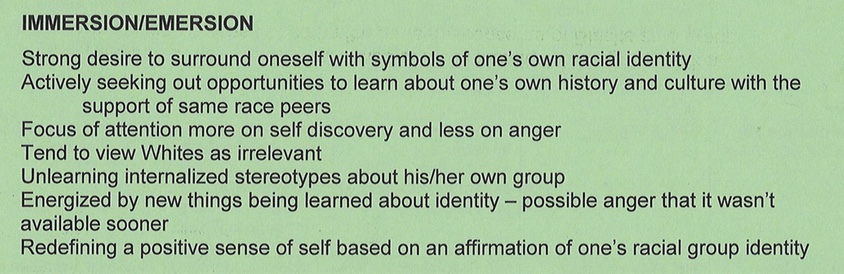
I grew up with culture loss in need of ongoing replenishment. The healing, nourishment, and abundance I feel when I am with womxn of color, queer people of color, and Latinx community feels like being known and welcomed home in a comforting, familial sense that I haven’t always experienced. By intentionally cultivating Latinx friendships I know myself better in relationship to my wider cultural/ancestral community/diaspora. Dr. Beverly Daniel Tatum would describe where I am this way:

From her book, Why Are All the Black Kids Sitting Together in the Cafeteria: And Other Conversations About Race

My process of reconciling my cultural identities has not always been supported by the spaces I’ve been in. I learned the hard way last year that I have very real limits when it comes to a predominantly white collectives because of what I need in my cultural healing journey. In those spaces I am prone to experiencing a lot of erasure and can end up not feeling fully seen, understood, or related to for all of who I am.

Since I grew up in North American suburbia, I am very assimilated and I know how to swim in predominantly white waters. So I can “pass” and have my third culture kid self and Latinx self overlooked. Or, if I am one of few POC in a group setting, I end up doing emotional labor – which for me feels like exploiting my own marginalized identities to educate/inform people or groups with privileged identities. It’s exhausting, and it’s not for me.

Here’s an honest perspective on what I observe in organizing: Centering POC/black/indigenous voices for a predominantly white audience can, at times, be a soft form of tokenism. Yes, a marginalized voice is centered, but who is it for? If the audience is mostly white, it still centers a white community and their learning. If the audience is made up of black/brown/migrant/indigenous folx, the goals and intent of designing and holding the space will likely be very different.

POC audiences have needs that are different than predominantly white audiences.

For a POC audience, it can look like designing and holding space to affirm and celebrate communal expressions that are trivialized by dominant culture. As a POC, there are safety cues I’m looking for: a level of warmth and hospitality, freedom to be expressive and affectionate, people who have my complex experiences in common, knowing that I won’t face an onslaught of micro aggressions, and working towards my community’s wellbeing. For a white audience, it can look like education, awareness, and examination of self in relation to systems of power and oppression – experiencing discomfort for the first time, developing resilience, and healing from the fiction of whiteness and racialized oppression.

Some of the work I’m doing this year is being really clear about who my audience is and how the project I’m designing is effectively resonating with that audience. Since setting boundaries for myself over the past year, I’ve become a lot more sensitive to which spaces foster anxiety and exactness – things that come from white supremacy – and which spaces feel whole, abundant, familial, restorative.

Art by Ricardo Levins Morales

Part of the myth and fiction of the United States is that white is standard, normal, neutral. And in organizing there are ways that white/dominant norms and the historical power associated with those norms go unexamined – which ultimately impedes the deeper recovery and liberation that is possible.

So this is an invitation to be honest about where we are in our identity formation, who our audiences are, and respect each other’s limitations, boundaries, and healing processes with compassion and generosity. Awareness is an important first step in healing from the longstanding effects of colonization. Knowing self and knowing the audience, and honoring the needs of all involved, is a foundation for organizing that meets people where they are. And we need each other at our best and most liberated.

Below is a list of my takeaways on leadership from the past year. Like this whole piece, it is incomplete and in constant progress – shared with the intent for mutual learning and constructive dialogue.

Do’s and Don’ts of Organizing

(and ways to be an equitable ally)

Do…

  • prioritize relationships over results
  • co-create, collaborate, practice consent in each step of the project
  • be flexible and malleable in design
  • have clear asks that respects folx’s time
  • be thoroughly self-aware about who you are in the project
  • be honest about your audience
  • allow for porous involvement that allows your collaborators to be at their most whole and have their needs met

Don’t…

  • make big asks for short term/temporary projects w/o long term partnership
  • organize in a single leader/director model
  • tokenize POC leadership when your audience is mostly white
  • claim “undoing oppression” and lead from a place of anxiety/urgency/scarcity/coercion
  • impose personal ambition in a collaborative effort
  • let internalized white supremacy go unexamined

Leadership is…

  • connecting people
  • reciprocal learning through sharing life experiences
  • lifting people up
  • compassion/generosity
  • non-anxious presence/facilitation
  • supporting a person’s journey
  • nurturing people when they are with you and releasing them when they are ready to evolve
  • extending generous, empathetic permission for change

Organizing is all cultivating relationships – it should be as simple as making a phone call. Do your research – know the individual or collective’s history and capacity, and be ready to either spend time on their turf cultivating a relationship OR have a clear ask that matches their capacity.

KonMari Method and Rituals for Transition

Today, Philadelphia had a ***SNOW DAY!***

After an ambitious week, I caught up on much needed rest and enjoyed quality Netflix time. Out of curiosity, I decided to watch Tidying Up with Marie Kondo, as I have been curious about the KonMari Method. Preview here:

Most of my friends know now that I am getting ready for a road trip this summer. I’m moving from Philadelphia to Los Angeles. In anticipation of leaving my dreamy West Philly bedroom with its beautiful bay windows where I have witnessed years’ worth of snow, springtime blossoms, and glorious sunsets, I am thinking about how I can simplify and travel with what is most meaningful to me. So naturally, Marie Kondo’s work was of interest to me.

Kondo has excellent strategies for tidying across the entire home. What I resonated with right away was the way she started the process in Episode 1. Before starting with any tasks or steps, she sat down with the family in the living room. She then facilitated a reflective moment of reverence and gratitude for the home-for being a place of safety, activity, life.

So often I can be preoccupied with work, creating, and organizing. But when I pause to take stock, I am abundantly aware of how my own space has been a place of love, rest, friendship, growth. I am deeply grateful for this place that has been my home, work, and creative space.

It’s the initial reflection of gratitude that then prepares the people who are tidying to practice gratitude when keeping, rearranging, and letting go. In the KonMari method, tidying is based on the question: Does this spark joy?

Gratitude is the action of the tidying method itself — each time you fold a clothing item, you are thanking the item for the joy it sparks in your life. And when you let it go, you thank it for the ways it has served you.

After doing an initial KonMari inventory of my clothing, I realized that I was able to wear the clothes that make me feel the most like myself more often, and I was able to release what I no longer needed. And by doing that, I emptied a whole dresser’s worth of storage space that I now have available to me. I am clearer on what I do want to invest my money in apart from clothing.

By releasing what I no longer need with gratitude, I am creating space to receive what I am creating and what is yet to be. This is a process that will continue for me throughout spring as I get ready to transition, but this initial practice was validating and affirming of all that I am holding in processing a transition. It allowed me to sit with a meaningful sense of gratitude for all that my West Philly home has been, and all that this city has been for me for the past 9 years. It allowed me to feel more excited about what I am making room for in my life.

To gratitude in letting go. To sparking joy. To remembering and releasing. To creating space for the new.